

I had a customer call in for an eviction on a three-story complex in Hermosa Beach. They had raccoons in the attic, and they’d already had multiple companies out. Nobody could get these guys out, and they were tenting the place within three days.
Anthony was the one who went to the initial call. Nobody wanted the job because of the height and how tricky it was, but he absolutely killed it once again.
Trapping Isn’t Always the Solution
Your normal pest control company that works for $20 an hour in a white, clean, collared shirt isn’t going to spend a couple hours figuring out a job like this. They’re not necessarily going to know what to do.
When it comes to animals, you might set up traps underneath the house or in the attic depending on the season. But if you have any reason to suspect there are babies in the attic or underneath the house, you do not want to automatically set traps without first figuring out what’s going on.
Because what happens when you trap the mom and the babies are unreachable? That’s when you can end up with babies dying in the wall, dying in the bathtub, dying in the subfloor, or dying somewhere else inside the house.
That’s why trapping companies that just say, “Oh, you have an animal in your house? I’ll come out and trap it,” aren’t necessarily the way to go. They need to do the inspection first to make sure there are no babies, and then inspect again afterward to make sure they got everything.
If they’re trapping animals, they need to make sure it’s not a skunk mom that just had babies, a raccoon that just had babies, or any other animal with young. You always gotta check.

You Need to Know What’s Going on Before You Trap
If you trap a mother and don’t know whether she is nursing, you can create a much bigger problem. If you do trap the mom, you need to check her. See if she’s nursing. See if she has swollen mammary glands. See if she’s been feeding babies. You have to know what you’re dealing with before deciding that trapping is the right solution.
Trapping is not always the solution. Sometimes pheromones are better, especially underneath houses or in attics. Sometimes trapping is needed, and when they’re all juveniles or older, that’s great.
In fact, most pest control companies are subbing out these animal jobs in attics to us. We don’t mind the work. We love the work. So we appreciate them using us, and we refer stuff to them that we’re not experts in. That’s just the way it works out.
Back to This Hermosa Beach Raccoon Job
Now, back to this job. It was three stories up, and they had what I believe was a half-moon vent — basically a half circle vent on the roof for ventilation. If you look at the photo, the raccoons were literally right there.
The companies that came out before did what you need to be very careful about doing. They set up traps without knowing if there were babies, without knowing what was going on, and they trapped the mom and took her away.
That can be one of the worst things you can do when you have animals underneath a house or in an attic — setting a trap without confirming whether there are babies.
This other trapping company took the mom away. We don’t know what they did with her, we don’t know their name, and then they left the babies for us to come solve the problem. Clearly, these are guys who just set traps for everything. That’s not the type of company you want to deal with. You want solutions.
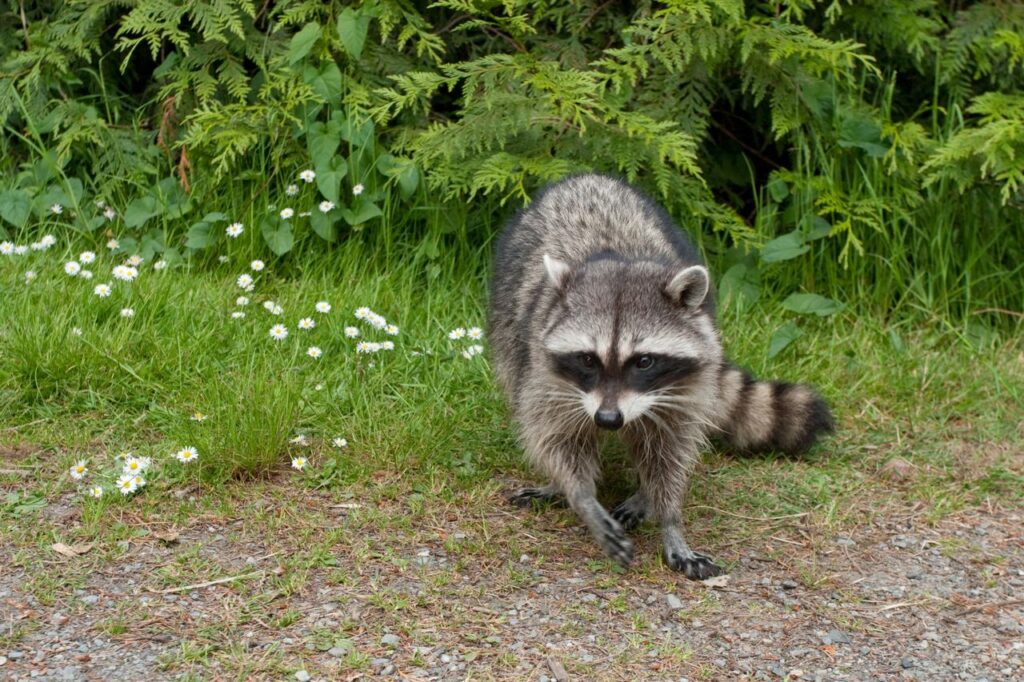
Anthony Finds the Raccoon Babies
So Anthony gets up there, shoots me a video and some photos, and tells us the babies are there. He can’t reach them with a snare, can’t reach them with the dog stick, so he talks to all of us and starts bouncing ideas off everybody.
What he ends up doing is an eviction treatment. Luckily, he could tell the babies were old enough to be hungry. He put out a little bit of food and could tell they were coming out to eat it, so he had a pretty good idea that they were old enough to leave.
So he did the eviction treatment. He sprayed the pheromone treatment and put something in there that would make them want to pick up and leave on their own. This works because raccoons have extremely strong noses. Anything that creates some type of discomfort through smell can affect them immensely, especially on a hot day. On top of that, he put out plenty of food to help lure them out.
Installing a One-Way Door
Now normally, you might think, “Okay, what’s gonna stop them from just going right back in?” That’s where he installed a one-way door.
We don’t always use one-way doors because babies can’t always get out of them unless the mom is there. Sometimes the mom will leave first and leave the babies behind. So you have to make sure the babies are actually old enough and capable of getting out on their own. In this case, Anthony thought they were old enough, so he installed the one-way door.
It worked great. You can see it right here. He went back, pulled the one-way door off, and they were tenting the building within the next day or two. They were gonna do the repair themselves.
As much as we wanted to, his installation of the one-way door almost looked like a good repair. They probably could’ve just left it behind. But this is where the one-way door and the eviction paid off at the same time.
What Did the Raccoon Eviction Cost?
The total charge was $625. Personally, I think he probably should’ve charged closer to $800 to $1,200 for the eviction and the one-way door. He spent two or three hours on the job.
But once again, you’re paying us for our expertise, our knowledge, and our experience. That’s the difference. You can keep hiring these other companies that charge you $300 to $500. Or, like the company before that, charge you $200 to come out, set traps, take away the mom, and leave you with the actual problem. That’s not gonna solve your problem. We’re interested in actually solving the problem.
When One-Way Doors Work
One-way doors work underneath homes when all of the animals are adults and they have a clear path to get out. But when you combine it with an eviction treatment, it can become even better.
The only time you don’t necessarily want to do this is when there are babies, you can’t reach them, and you’re not sure they’re old enough to leave on their own. If they’re adults or older juveniles, this can work great. It can work for skunks. It can work for raccoons. Possums — I think it can work too, but possums are a little different because they’ll have babies attached to them, and they’ll constantly drop them and leave them behind. So it’s a little different.
You should still probably do an inspection afterward and make sure you actually got everything. Because even if you’re great at trapping, you can still end up leaving one animal behind. You have to be really thorough with your inspection before you give the approval and say: “Yeah, the job is solved.”
Every Animal Eviction Is Different
On a normal eviction, you might not need to do that. If you’re really good at your evictions, you might not even need to go back. But when you’re doing one-way doors and evictions, or you’re dealing with animals of different ages, every job is different.
There is no exact answer. There’s no exact way to do the same job every single time. It’s not a formula. It’s something you figure out with experience when you get to the job.
That’s the difference between just trapping an animal and actually solving the problem.