

If you’ve been noticing more skunk activity around your property in October than at other times of year, you’re not imagining it. October is one of the more active months for skunks, and the reason is specific: skunks spend the fall making preparations for winter in what wildlife professionals refer to as the fall shuffle. During this period, skunks are more visible, more mobile, and more likely to move into or around residential properties than they are during the quieter summer months. Understanding what drives this behavior explains why skunks are out in October in greater numbers — and why acting on it quickly matters.
Skunks don’t hibernate the way bears do, but they do enter a period of reduced activity during the coldest winter months — particularly in colder climates. In Southern California, true dormancy is rare because winters are mild, but skunks still respond to dropping temperatures and shorter days by instinctively shifting their behavior in the fall.
The fall shuffle is essentially a preparation phase. Skunks spend October moving more actively through their range, doing several things at once: eating heavily to build up fat reserves for the slower winter period, scouting and securing a reliable den site to spend cold spells in, and in some cases shifting territory entirely if their current range doesn’t offer adequate winter shelter.
All of that activity happens at once, which is why October tends to produce more skunk encounters, more skunk smell near structures, and more reports of skunks investigating properties that hadn’t seen much activity earlier in the year.
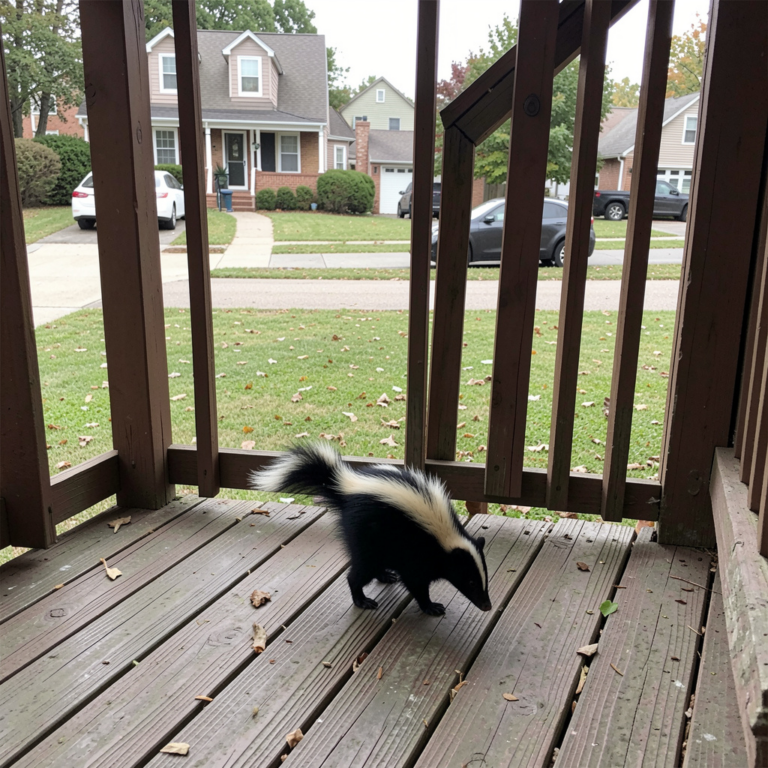
One major driver of October skunk activity is food. Before temperatures drop and insect populations thin out, skunks feed heavily to build up body fat that will sustain them through periods of reduced activity. This means more foraging, more digging in lawns for grubs, more investigation of trash cans and compost bins, and a wider nightly range as skunks cover more ground looking for high-calorie food sources.
A lawn that had minor skunk digging activity through the summer may suddenly show heavier overnight damage in October as the same animal or animals increase their foraging intensity. Pet food left outside overnight, unsecured garbage, and fallen fruit from trees all become more attractive targets during this feeding push.
The other half of the fall shuffle is shelter. A skunk that’s been sleeping in temporary spots through the warmer months — dense vegetation, brush piles, shallow burrows — will use October to find something more substantial for winter. That means evaluating residential structures.
Crawl spaces, gaps under decks, spaces beneath sheds, and any accessible enclosed area that stays dry and maintains some warmth are exactly what a skunk is looking for heading into winter. October is the month when skunks actively probe foundation perimeters, sniff along deck skirts, and test vent covers — looking for the entry point that will become their winter den.
A property that hadn’t had a visible skunk problem through spring and summer can suddenly have one in October simply because a skunk doing its fall shuffle found an accessible entry point and decided to move in before the cold sets in.
The temptation when you notice skunk activity in October is to assume it’ll taper off once winter arrives. Sometimes that’s true for a skunk that’s just passing through on an expanded range. But a skunk that’s actively den-shopping in October isn’t passing through — it’s looking for a place to stay for the next several months.
A skunk that moves into a crawl space or under a deck in late October may stay through February or March. If it’s a pregnant female — breeding activity picks up again in late winter — she may remain even longer while she raises her litter. What looks like a brief uptick in fall activity can transition directly into a multi-month denning situation without any clear stopping point.
The fall shuffle is also the period when skunks are more willing to move into unfamiliar spaces because the seasonal pressure to secure winter shelter outweighs their usual caution. A property they might have bypassed in July becomes worth investigating in October.
Based on over 2000 reviews
If you’re still asking why skunks are out in October, the answer is clear: they’re looking for food and a place to spend winter. Addressing it before a den is established is significantly easier and less involved than removing an animal that’s been settled under your structure since Halloween.
At All City Animal Trapping, we know the fall shuffle well. We’ve been handling skunk removals across Los Angeles, Orange County, Riverside, and San Bernardino for over 20 years, and October is one of our busiest months for exactly this reason. We’ll remove the animal, seal the entry point, and make sure your structure isn’t the one a skunk picks for its winter den.
Call us at (877) 724-5314 for a free consultation and speak with a live trapper today — before the fall shuffle becomes a winter problem.