


Finding a skunk beneath your deck is not exactly how you want to start your morning. Maybe your dog has been sniffing around the same corner of the yard, you’ve noticed a strong musky odor near the patio, or you’ve spotted a black-and-white animal disappearing underneath the boards after sunset.
Your first instinct might be to scare it away or block the opening so it cannot return. Unfortunately, either approach can make the situation more complicated.
If you have a skunk under your deck in Los Angeles, the safest first step is to keep people and pets away, avoid disturbing the animal, and determine whether it is using the space as a temporary shelter or an established den.
At All City Animal Trapping, we help Southern California homeowners handle unwanted wildlife around decks, patios, crawlspaces, and other areas of their properties. Our approach focuses on identifying the animal, understanding why it is there, and choosing a removal and prevention plan that fits the situation.
Why Do Skunks Hide Under Decks?
A deck can provide nearly everything a skunk wants in a daytime shelter: shade, protection from weather, limited human activity, and a concealed place to rest.
Many Los Angeles properties have raised wooden decks, patios, sheds, or other structures with open spaces underneath. These sheltered areas can be especially appealing when nearby landscaping provides food and additional cover.
Skunks are generally most active from dusk through the night. During daylight hours, they often rest in protected locations, including burrows, spaces beneath structures, and other sheltered areas.
A skunk may visit your yard while searching for food without actually living beneath your deck. However, repeated activity near the same opening can indicate that the animal has established a regular shelter.
What attracts skunks to Los Angeles yards?
Skunks are opportunistic feeders. Depending on the season and location, they may search for insects, grubs, fallen fruit, and other available food.
Residential yards can offer several attractions:
-
Pet food left outdoors overnight.
-
Unsecured trash or food scraps.
-
Fallen fruit beneath trees.
-
Insects and grubs in lawns or garden beds.
-
Openings beneath decks, sheds, and crawlspaces.
-
Dense vegetation that provides cover.
A property does not have to be neglected to attract wildlife. Even a well-maintained garden can offer shelter and natural food sources.
The goal is to identify which conditions may be encouraging the animal to stay.
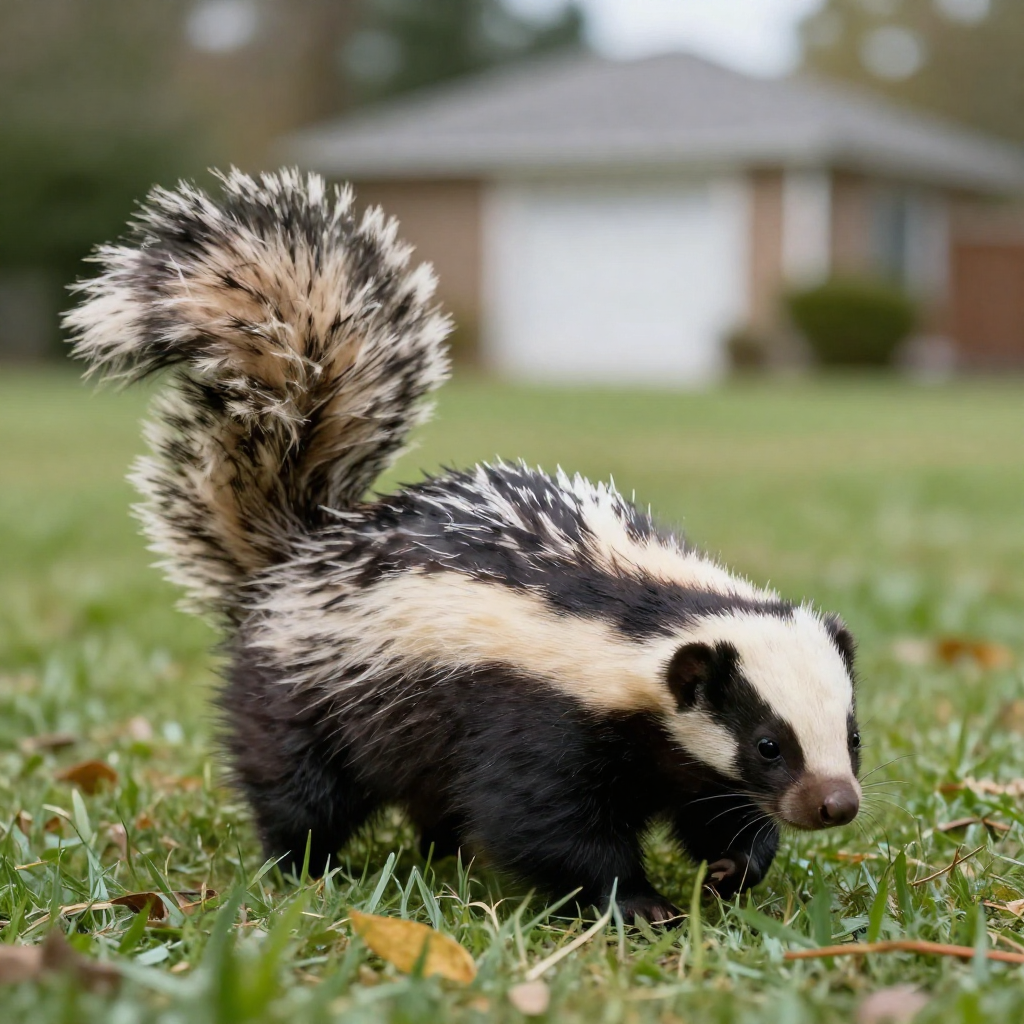
How Can You Tell If a Skunk Is Living Under Your Deck?
Seeing a skunk in the backyard once does not necessarily mean it has moved in.
Skunks can travel through residential neighborhoods while searching for food. The more useful question is whether you are seeing repeated signs around a specific sheltered area.
1. Repeated sightings near the same opening
If a skunk consistently emerges from beneath your deck around dusk or disappears into the same gap before sunrise, it may be using that location as a den.
Observe only from a safe distance. Do not approach the opening with a flashlight or attempt to look inside.
2. A persistent musky odor
Skunks naturally produce a distinctive odor, but smelling something unpleasant does not automatically mean the animal has sprayed.
A lingering smell can indicate nearby skunk activity, although the source should be confirmed before planning removal.
If the odor becomes suddenly intense, avoid investigating the area closely.
3. Small holes in the lawn
Skunks may dig small, shallow holes while searching for insects and grubs.
These feeding holes can appear in lawns, garden beds, or landscaped areas.
However, digging alone does not identify the animal. Other wildlife can disturb soil in similar ways.
4. Disturbed soil around the deck
Loose soil or signs of digging near a deck’s perimeter may suggest that an animal is entering or enlarging an opening.
Look for patterns of activity rather than relying on one mark.
5. Noises beneath the structure
Scratching, rustling, or movement beneath a deck can indicate wildlife activity.
Sounds alone cannot confirm that the animal is a skunk. Raccoons, opossums, rodents, and other animals may use similar spaces.
A proper wildlife inspection can help identify the animal before any removal work begins.
What Should You Do Immediately If You Find a Skunk Under Your Deck?
The most important thing is to avoid turning a manageable wildlife problem into a confrontation.
Skunks usually prefer to avoid people, but they may defend themselves when frightened, cornered, or unable to escape.
Keep children and pets away
Prevent children from playing near the deck opening until the situation has been assessed.
Keep dogs on a leash when using the yard, particularly around dusk and early morning.
A curious dog may rush toward the skunk before you have time to intervene.
Do not approach or corner the animal
Avoid trying to chase the skunk out with a broom, garden hose, or loud equipment.
The animal needs a clear escape route. Blocking that route while approaching from the other side can increase the chance of defensive behavior.
Avoid placing your hands near the opening
Do not reach beneath the deck, even if you believe the skunk is asleep or has left.
You may not be able to see the entire space, and there could be more than one animal present.
Do not seal the entrance immediately
Closing the opening while an animal remains underneath can trap it.
If young animals are present, sealing the entrance may separate them from their mother.
Exclusion work should be coordinated with confirmation that the space is clear.
Arrange a professional assessment
If the skunk is repeatedly using the area, an experienced animal removal service can help determine an appropriate next step.
This is particularly important when the space is difficult to access or the animal may be caring for young.
Will a Skunk Spray If You Get Too Close?
A skunk’s spray is a defensive tool, not something it normally uses without reason.
Skunks may give warning signals before spraying. These can include stamping their feet, raising their tails, or changing their body position.
However, you should never rely on receiving a warning.
An animal that feels threatened or surprised may react quickly.
If you see a skunk displaying defensive behavior, stop approaching and calmly move away. Do not attempt to photograph it at close range or encourage it to move.
What if your dog gets sprayed?
If your dog encounters a skunk, move the pet away from the area and check for injuries.
Skunk spray can irritate the eyes and other sensitive tissues. If your pet is squinting, drooling excessively, vomiting, or showing other concerning symptoms, contact a veterinarian.
Avoid letting a heavily sprayed pet rub against furniture or carpeting before cleaning.
Do not use harsh chemicals or untested home remedies on your pet.
If there was a bite or direct physical contact, seek veterinary guidance promptly, including advice about rabies exposure.
Can a Skunk Have Babies Under Your Deck?
Yes. A sheltered space beneath a deck or porch may be used as a den by a mother skunk with young.
This is one reason homeowners should not assume that an opening can be sealed as soon as the adult animal leaves.
A mother may leave the den temporarily to find food while her young remain hidden.
If the entrance is blocked during that time, the animals can become separated.
Attempting to remove the young without appropriate training can also create safety and animal welfare concerns.
How do you know if baby skunks are present?
It is not always possible to tell from outside.
Repeated activity at a den entrance during the breeding and rearing season may raise the possibility, but it does not prove that young are present.
A professional should assess the situation before recommending exclusion or removal.
At All City Animal Trapping, we consider the possibility of dependent young when planning work around sheltered wildlife dens.
The priority is to avoid an unnecessary confrontation or a situation that leaves animals trapped beneath the structure.
Why DIY Skunk Removal Can Make the Problem Worse
Homeowners often search for a quick way to get a skunk out from beneath a deck.
Unfortunately, many commonly suggested methods are unreliable or create unnecessary risks.
Spraying water into the den
A hose may frighten the animal without causing it to leave permanently.
It can also create a defensive reaction or disturb young animals.
Using loud music or constant noise
Noise may temporarily change wildlife behavior, but it is not a dependable substitute for inspection and appropriate removal.
It may also disturb neighbors without solving the underlying problem.
Using mothballs or strong chemicals
Mothballs are pesticides intended for specific labeled uses, not general wildlife repellents.
Placing them beneath decks or around wildlife dens can create risks for people, pets, and the environment.
Do not use household chemicals in ways that are inconsistent with their labels.
Blocking the opening with concrete or boards
This may seem like the simplest permanent solution.
However, if the skunk is still inside, the result can be a trapped animal, damage to the structure, or an animal attempting to escape through another opening.
Attempting to trap the skunk yourself
Handling a trapped skunk presents obvious spraying and bite risks.
Wildlife trapping and relocation may also be subject to California regulations.
For these reasons, we recommend seeking professional guidance rather than experimenting with removal methods.
How Professional Skunk Removal Works
No two properties are exactly alike.
A raised deck with one visible opening is different from a low patio with several hidden access points. A skunk passing through the yard also requires a different response from a mother using a den.
At All City Animal Trapping, we begin with an assessment of the property and the reported activity.
Step 1: Inspect the deck and surrounding yard
We look for likely entry points, signs of repeated use, and conditions that may be attracting the animal.
We also consider whether other wildlife could be responsible for the activity.
Step 2: Evaluate the den situation
Before recommending exclusion, we assess whether the space appears occupied and whether dependent young may be present.
This helps determine the safest sequence of work.
Step 3: Develop an appropriate removal plan
The recommended method depends on the species, site conditions, safety concerns, and applicable wildlife rules.
We explain the proposed approach so the homeowner understands what will happen.
Step 4: Address access points
After the area has been confirmed clear, vulnerable openings may need exclusion repairs.
The goal is to prevent another animal from moving into the same space.
Step 5: Recommend prevention measures
We may suggest changes to food storage, trash management, landscaping, or other conditions that encourage skunk activity.
Removal addresses the immediate animal problem. Prevention helps reduce the chance of it returning.
How to Keep Skunks From Getting Under Your Deck Again
Once the space is no longer occupied, it is worth addressing why the skunk was able to use it.
Install appropriate exclusion barriers
A properly designed barrier can protect accessible openings around a deck or similar structure.
The installation should account for the surrounding soil, drainage, ventilation, and the way the structure is built.
Simply attaching lightweight material over a visible gap may not provide durable protection.
Remove outdoor food sources
Bring pet food indoors after feeding.
Keep garbage containers securely closed, and clean up fallen fruit when practical.
Avoid leaving food scraps where wildlife can reach them.
Maintain the yard
Trim dense vegetation around structures where appropriate.
Check for new digging activity and changes around deck edges, crawlspace openings, and sheds.
Inspect vulnerable areas periodically
Outdoor structures change over time.
Soil can settle, barriers can become damaged, and new gaps can appear after landscaping or construction work.
A periodic visual check can help you identify openings before animals begin using them.
If you are already dealing with repeated wildlife activity, our wildlife exclusion and attic protection services can help identify broader access concerns around the property.
What If You Smell a Skunk but Cannot Find It?
A skunk odor does not always mean the animal is living beneath your deck.
A skunk may have sprayed nearby, passed through the yard, or encountered another animal.
Odors can travel and linger, especially in sheltered outdoor areas.
Start by keeping pets away from the location where the smell is strongest.
Do not crawl under a deck to investigate.
If the odor continues or you notice repeated digging, sightings, or movement, arrange an inspection.
A professional can look for evidence of current activity rather than assuming that every odor requires trapping.
Are Skunks Dangerous to People and Pets?
Skunks generally avoid human contact, but they are still wild animals.
They can bite when handled or cornered, and they may carry diseases that affect humans or other animals.
The Centers for Disease Control and Prevention identifies skunks among the wild animals that can be associated with rabies in the United States.
That does not mean every skunk is infected. It does mean that bites and potential exposures should be treated seriously.
If someone is bitten or scratched, wash the affected area and seek medical guidance promptly.
If a pet has been bitten or had direct contact with a skunk, contact a veterinarian.
Avoid handling an animal that appears unusually disoriented, unable to move normally, or abnormally aggressive.
Report concerning wildlife behavior to the appropriate local animal control or public health authority.
When Should You Call for Skunk Removal in Los Angeles?
Consider professional help when a skunk repeatedly enters beneath your deck, you suspect a den with young, or pets are regularly encountering the animal.
You should also arrange assistance when the access point is difficult to reach or when previous attempts to discourage the animal have not worked.
A one-time sighting in the yard may not require removal.
Repeated use of a sheltered space, however, can justify an inspection and a prevention plan.
At All City Animal Trapping, we help property owners in Los Angeles and surrounding Southern California communities address skunk activity without relying on guesswork.
Our team can assess the property, explain the likely situation, and recommend next steps.
Key Takeaways
-
A skunk beneath a deck may be resting temporarily or using the space as an established den.
-
Keep children and pets away, and avoid cornering or frightening the animal.
-
Do not seal an opening until the space has been confirmed clear.
-
Dependent young may be present, especially when an adult repeatedly uses the same den.
-
Trapping, exclusion, and prevention should be planned according to the actual conditions.
-
Removing accessible food sources and repairing openings can help discourage future activity.
Frequently Asked Questions About Skunks Under Decks
How do I get a skunk out from under my deck?
Avoid approaching, spraying, or sealing the animal inside. Keep people and pets away and arrange an inspection to determine whether the skunk is temporarily sheltering or using an established den.
Will a skunk leave on its own?
Sometimes. A skunk may use a location briefly and move on. However, an established den, particularly one containing young, may remain occupied for longer.
What time do skunks usually come out?
Skunks are generally most active around dusk and during nighttime hours, although activity can vary.
Can I block the hole under my deck?
Only after confirming that no animals remain inside. Sealing an occupied den can trap adults or dependent young.
Does skunk spray mean there is a den nearby?
Not necessarily. A skunk may spray during an encounter while passing through the area. Repeated sightings and activity around an opening provide stronger evidence of a den.
Is it safe to trap a skunk myself?
DIY trapping carries risks of spraying, bites, and improper handling. California wildlife rules may also apply. Professional guidance is recommended.
How can I stop skunks from returning?
Reduce accessible food sources, secure trash, inspect sheltered spaces, and repair entry points after the area has been confirmed unoccupied.
Conclusion: Get Help With a Skunk Under Your Deck in Los Angeles
Finding a skunk beneath your deck can be stressful, especially when you have children or pets that use the yard.
The best response is not to force the animal out immediately. It is to understand whether the space is occupied, avoid unnecessary contact, and address the entry point once the situation has been resolved.
At All City Animal Trapping, we help homeowners with skunk removal in Los Angeles, including inspections, appropriate removal planning, and recommendations for preventing wildlife from returning.
If you have a skunk under your deck, call (877) 724-5314 to discuss the situation and request an inspection.