

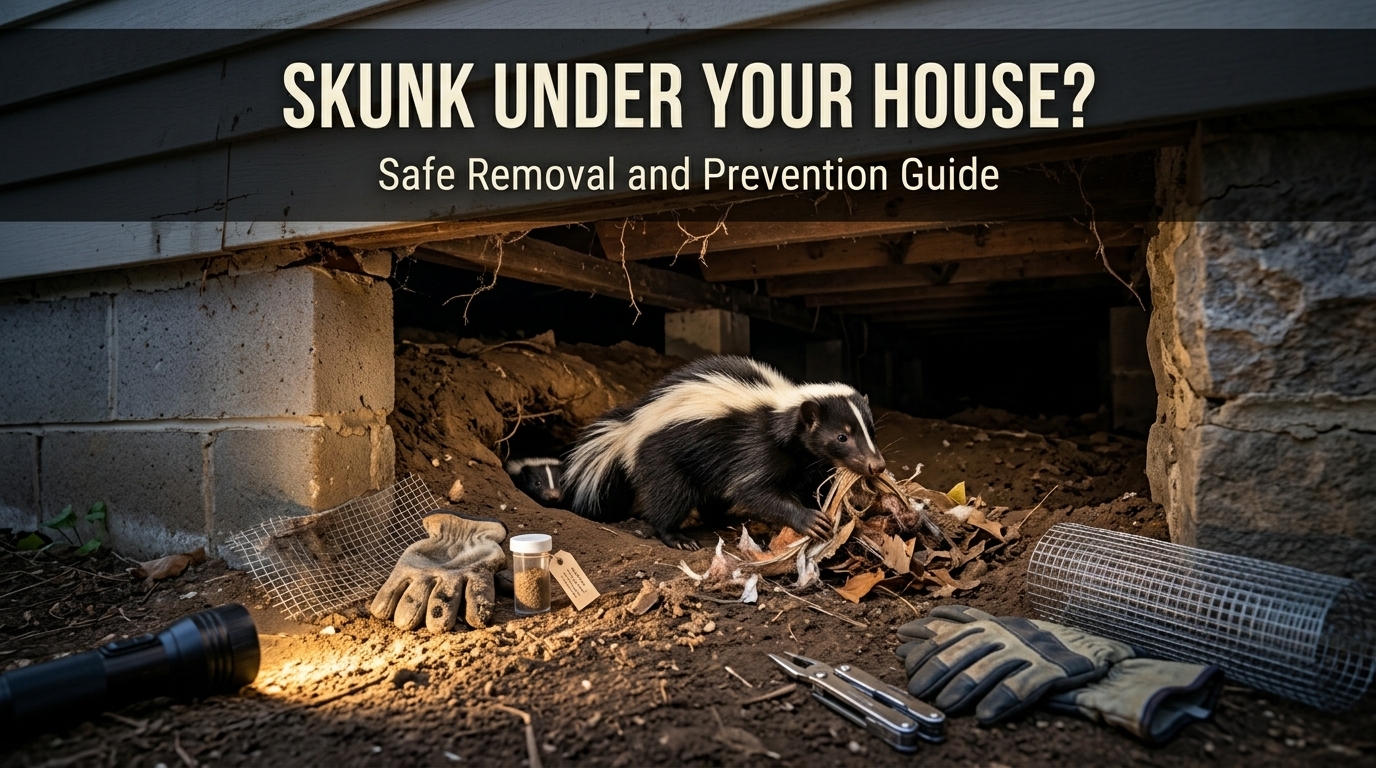
You step outside in the evening and notice a strong, unpleasant smell near your porch. A few days later, you discover a small opening beneath the foundation or see an animal moving toward the crawlspace.
You may begin wondering whether a skunk has made a den beneath your home.
Skunks are common in many developed environments where they can find food, water, and protected shelter. Although they generally prefer to avoid confrontation, they may use spaces beneath houses, decks, sheds, and other structures as resting or denning locations.
If you suspect a skunk is living under your house, avoid blocking the entrance or attempting to trap the animal yourself. First, confirm whether the space is occupied, identify possible entry points, and determine whether dependent young are present. Professional removal and exclusion can help address the problem safely.
At All City Animal Trapping, we help homeowners throughout Los Angeles, Orange County, Riverside, and surrounding Southern California communities investigate unwanted wildlife activity and develop appropriate removal and prevention plans.
This guide explains why skunks shelter beneath homes, how to recognize the warning signs, what removal methods may be appropriate, and how to reduce the chance of another animal returning.
Why Do Skunks Live Under Houses?
Skunks are adaptable animals that may use natural burrows or sheltered spaces beneath structures.
A crawlspace or opening beneath a home can offer several advantages.
Protection from weather
A sheltered area beneath a house may provide protection from rain, wind, and temperature changes.
Reduced disturbance
Spaces beneath porches, decks, and raised foundations often experience limited human activity.
This makes them attractive resting locations.
Denning opportunities
Female skunks may use protected spaces when raising their young.
A suitable opening beneath a building can become a denning site.
Nearby food sources
Skunks feed on a variety of foods, including insects and other small animals.
They may also investigate accessible garbage, fallen fruit, and pet food.
Easy access beneath structures
Damaged crawlspace panels, gaps around foundations, and openings beneath decks may provide access.
An animal may begin using a space simply because the entrance is accessible and the area offers shelter.
7 Signs a Skunk May Be Living Under Your House
A skunk passing through your yard does not necessarily mean it has established a den.
However, repeated activity near the same sheltered opening may indicate that the animal is using the space.
1. Repeated skunk sightings
Seeing a skunk entering or leaving the same opening on multiple occasions may suggest regular use.
Skunks are often active after dark, although they may occasionally be seen during daylight hours.
2. A strong skunk odor
A skunk’s defensive spray has a distinctive odor.
However, the smell alone does not prove that a skunk is living beneath the house.
An animal may have sprayed nearby or passed through the area.
3. A visible opening beneath the structure
An accessible gap beneath a porch, shed, deck, or foundation may provide shelter.
Signs of disturbed soil around the opening may suggest animal activity.
4. Digging near the foundation
Skunks may dig while searching for food or accessing sheltered spaces.
Small holes in lawns and landscaped areas may also indicate foraging activity.
5. Scratching or movement sounds
An animal moving beneath the floor may produce scratching or rustling sounds.
These noises are not specific to skunks and could be caused by other wildlife.
6. Tracks near the entrance
Footprints in soft soil may provide clues about the animal using an opening.
Accurate identification requires examining the tracks and other evidence.
7. Activity involving young animals
During the breeding season, a female skunk may occupy a den with dependent young.
Young animals may eventually be seen near the entrance as they develop.
The presence of offspring changes how removal and exclusion should be planned.
How Can You Tell if a Skunk Is Under Your Crawlspace?
A crawlspace may be occupied by skunks, opossums, cats, or other animals.
Correct identification is important because different species require different responses.
Observe from a safe distance
If an animal is visible, avoid approaching it.
Watch from a secure location without blocking its route.
Note the timing of activity
Skunks are generally more active at night.
However, nighttime activity alone does not confirm the species.
Look for entry points
Inspect accessible exterior areas for gaps, disturbed soil, and repeated movement near an opening.
Do not crawl beneath the house to investigate an occupied space.
Consider other possible animals
An opossum or another animal may use the same type of shelter.
A strong odor may suggest a skunk has been nearby, but it is not definitive evidence of an active den.
A professional inspection can help determine which animal is responsible.
Is It Dangerous to Have a Skunk Under Your House?
The level of risk depends on the animal’s behavior, the location, and whether people or pets are likely to encounter it.
Skunks generally avoid confrontation, but problems can develop when they are frightened or cornered.
Defensive spraying
Skunks may spray when they feel threatened.
The odor can affect outdoor areas and may enter nearby building spaces.
Bites and scratches
Skunks are wild animals and may bite or scratch if handled or trapped.
Rabies concerns
Skunks are among the wildlife species that can carry rabies in North America.
However, seeing a skunk does not mean it has rabies.
Avoid direct contact, particularly if the animal appears unusually disoriented, aggressive, paralyzed, or otherwise abnormal.
If a person is bitten or scratched, wash the wound and seek prompt medical advice. If a pet is exposed, contact a veterinarian.
Dependent young
A mother skunk may defend access to a den containing young.
Premature exclusion can separate the family and create additional animal welfare concerns.
Property concerns
Digging beneath structures may disturb soil or landscaping.
The extent of any structural concern depends on the property and should not be assumed without inspection.
What Should You Do if a Skunk Is Under Your House?
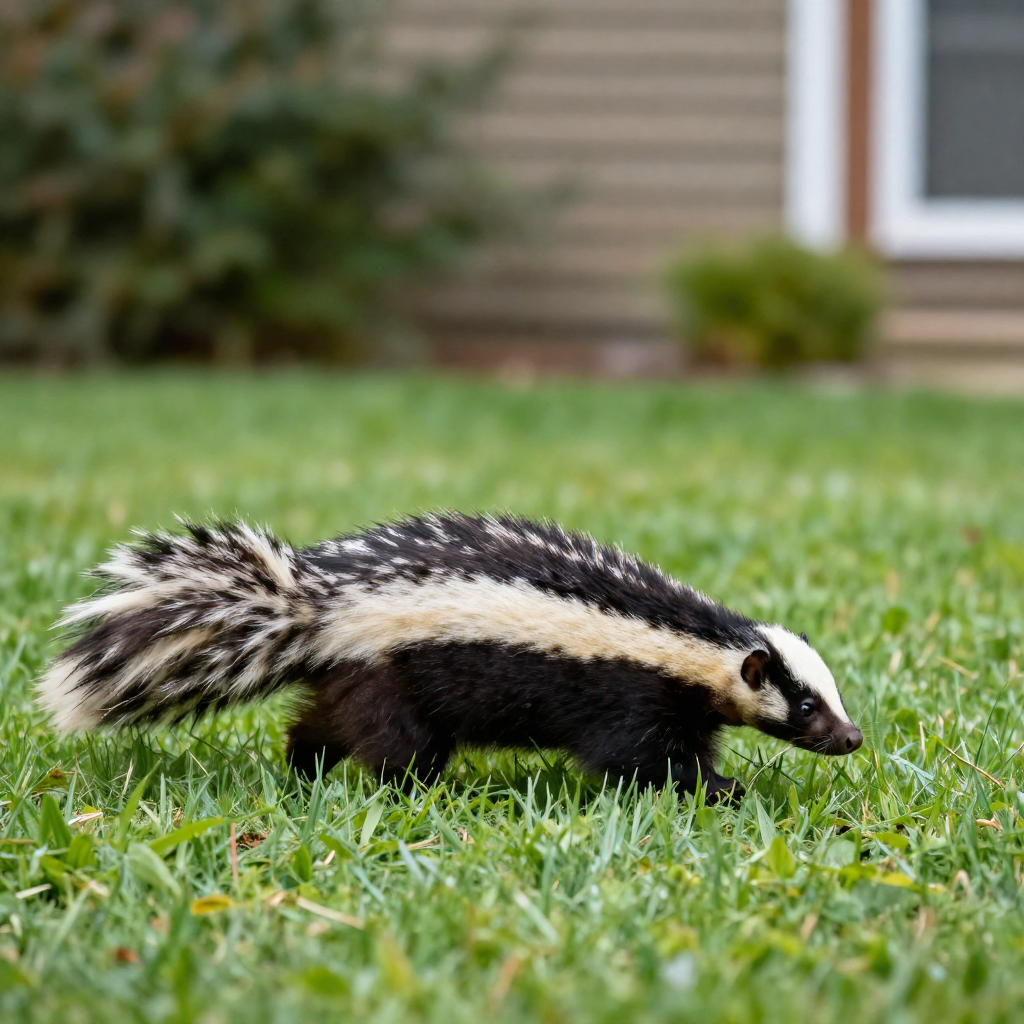
Finding a skunk beneath your home can be stressful, especially if the entrance is near a walkway, patio, or doorway.
The safest immediate response is to avoid confrontation.
Step 1: Keep people and pets away
Prevent pets from approaching the suspected den.
Keep children away from the opening.
Step 2: Do not corner the skunk
Skunks may spray when they feel threatened.
Give the animal space and avoid blocking its escape route.
Step 3: Avoid entering the crawlspace
Do not crawl beneath the house to investigate an occupied den.
The area may contain wildlife, contaminated materials, or physical hazards.
Step 4: Do not seal the opening immediately
Blocking an entrance while animals remain inside may trap them.
If dependent young are present, the mother may be unable to return.
Step 5: Observe activity from a distance
Note whether the animal enters or exits the same opening.
Record the approximate time and location of sightings.
Step 6: Arrange a wildlife inspection
A professional can assess the evidence, identify the species, and recommend an appropriate response.
For more information about professional wildlife management, visit our animal removal services.
How Do You Get Rid of a Skunk Under Your House?
The appropriate method depends on whether the animal is actively using the space, whether dependent young are present, and which wildlife regulations apply.
There is no single removal method suitable for every situation.
Confirm the animal’s identity
Skunks, opossums, and other animals may occupy similar spaces.
Correct identification helps avoid inappropriate trapping or exclusion.
Determine whether the den is occupied
An animal may use a shelter temporarily or establish a more regular den.
The removal plan should account for current occupancy.
Check for dependent young
Young skunks may be unable to leave independently.
A removal approach that ignores dependent young can create additional problems.
Select an appropriate removal method
Depending on the circumstances, professional wildlife management may involve trapping or other lawful approaches.
California regulations can restrict trapping methods and the handling or relocation of captured wildlife.
The California Department of Fish and Wildlife’s Living with Wildlife resources provide information about wildlife conflicts and appropriate responses.
Address the entry point
Once the affected space is confirmed clear, the opening can be evaluated for appropriate exclusion repairs.
Reduce attractants
Securing food sources and maintaining the property can help reduce future wildlife activity.
Our skunk removal services can help homeowners understand removal and prevention considerations.
Can You Use Repellents to Drive Skunks Away?

Homeowners sometimes try commercial repellents, strong odors, lights, or noise to encourage skunks to leave.
However, these methods are not reliable substitutes for proper inspection and exclusion.
Some products may be ineffective, while others can create unnecessary exposure risks for people, pets, or wildlife.
Avoid using hazardous chemicals or improvised methods beneath occupied structures.
Do not use smoke, fire, flooding, or other dangerous techniques to force an animal from a den.
A better approach is to identify the animal, assess the space, and develop an appropriate removal plan.
Why You Should Not Seal a Skunk Den Too Early
Closing a den opening may appear to be the fastest way to solve the problem.
However, premature closure can make the situation worse.
Animals may remain inside
A skunk may be resting beneath the structure when the opening is sealed.
Dependent young may be trapped
If a mother is outside while young remain inside, sealing the opening can prevent her from returning.
Animals may search for another exit
A trapped animal may attempt to dig or move through other vulnerable areas.
Odor and sanitation problems may develop
An animal that cannot escape may die in an inaccessible space.
Before permanent exclusion, the affected area should be confirmed clear.
How Professional Skunk Removal Works
At All City Animal Trapping, we focus on identifying the wildlife problem and developing a practical response.
Step 1: Initial consultation
We review the homeowner’s observations, including sightings, odors, digging, and suspected den locations.
Step 2: Exterior inspection
We assess accessible areas around the foundation, deck, porch, shed, or crawlspace.
Step 3: Species identification
We evaluate the evidence to determine whether skunks or another animal may be responsible.
Step 4: Den assessment
We consider whether the space is occupied and whether dependent young may be present.
Step 5: Removal planning
The recommended approach depends on the animal, property conditions, and applicable wildlife requirements.
Step 6: Wildlife removal
Removal should account for household safety and animal welfare.
Step 7: Exclusion recommendations
Once the area is confirmed clear, vulnerable openings can be addressed using suitable materials.
Step 8: Prevention planning
We review food sources, access routes, and property conditions that may encourage future activity.
How Much Does Skunk Removal Cost?
Skunk removal costs vary depending on the location, accessibility, and complexity of the problem.
A single skunk using an accessible outdoor shelter is different from a family occupying a difficult-to-reach crawlspace.
Factors that may affect the scope include:
-
The number of animals.
-
Whether dependent young are present.
-
The location of the den.
-
Accessibility beneath the structure.
-
The removal method required.
-
Follow-up requirements.
-
Exclusion repairs.
-
Cleanup or restoration needs.
An inspection can help determine the work required.
When comparing estimates, ask whether the service includes inspection, removal, follow-up, and exclusion.
Avoid assuming that the lowest initial price includes all the work needed to prevent a recurring problem.
How to Prevent Skunks From Living Under Your House
Prevention focuses on making sheltered spaces less accessible and reducing attractants.
Inspect crawlspace openings
Check accessible exterior areas for damaged panels and gaps.
Maintain decks and porches
Look for openings beneath raised structures.
Do not seal an opening until the space is confirmed clear.
Secure garbage
Use containers with secure lids.
Remove outdoor pet food
Avoid leaving pet food accessible overnight.
Collect fallen fruit
Fruit and other food sources may attract wildlife.
Maintain landscaping
Reduce unnecessary clutter and monitor areas where animals may shelter.
Address accessible water sources
Repair leaking outdoor faucets and manage standing water where practical.
Monitor for renewed digging
Fresh soil disturbance near an excluded area may indicate that further assessment is needed.
Exclusion and maintenance can reduce opportunities for skunks to return, but no property can be made completely wildlife-proof.
What if a Skunk Sprays Near Your House?
Skunk spray can produce a strong odor that affects nearby outdoor areas and sometimes enters the home.
The appropriate response depends on where the spray occurred.
Increase ventilation when appropriate
If outdoor air is clear of the odor, ventilation may help reduce lingering smells indoors.
Avoid direct contact with contaminated materials
Use appropriate precautions when handling affected items.
Keep pets away from the area
Pets may investigate the location and encounter the animal again.
Do not mix household chemicals
Combining cleaning products can create dangerous fumes.
Use cleaning products only according to their labels and avoid improvised chemical mixtures.
Identify whether the animal remains nearby
A spray incident does not necessarily mean a skunk is still living beneath the structure.
Repeated activity near the same opening may warrant inspection.
Skunk Removal in Southern California
Skunks may use sheltered spaces around homes throughout Southern California.
The conditions vary by property rather than by city alone.
Los Angeles County
Homes with raised foundations, decks, sheds, and landscaped outdoor areas may provide potential denning locations.
Orange County
Residential properties near parks, landscaped areas, and open spaces may experience skunk activity.
Riverside County
Skunks may investigate crawlspaces, outdoor structures, and sheltered foundation areas.
San Bernardino County
Properties with accessible openings beneath structures may provide opportunities for wildlife shelter.
These examples describe possible conditions, not confirmed local infestation rates.
A property-specific inspection is the best way to determine whether a skunk is using a particular space.
Skunk Removal vs. Skunk Prevention
Removal and prevention address different parts of a wildlife problem.
Skunk removal focuses on an animal currently occupying an unwanted location.
Skunk prevention focuses on reducing access and attractants that may encourage future activity.
A complete approach may require both.
For example, removing a skunk from beneath a deck without addressing the opening may allow another animal to use the same shelter.
Similarly, securing garbage may reduce wildlife visits but will not necessarily remove an animal already occupying a crawlspace.
The most effective plan considers both the immediate situation and the property conditions.
Key Takeaways
-
Skunks may shelter beneath houses, decks, porches, sheds, and crawlspaces.
-
Repeated sightings near the same opening may indicate denning activity.
-
Skunk odor alone does not confirm an occupied den.
-
Avoid approaching, cornering, or attempting to handle a skunk.
-
Dependent young must be considered before removal or exclusion.
-
Do not seal an opening until the space is confirmed clear.
-
Exclusion repairs and reducing attractants can help prevent repeated wildlife problems.
Frequently Asked Questions About Skunks Under Houses
How do I know if a skunk is living under my house?
Repeated sightings near the same opening, disturbed soil, digging, and movement sounds may indicate activity. A strong odor can be a clue but does not confirm an occupied den.
Will a skunk leave from under my house on its own?
Some skunks use sheltered spaces temporarily, while others establish dens. If dependent young are present, the animal may continue using the location until they are able to leave.
Can I block the hole while the skunk is outside?
Blocking an opening without confirming the space is clear may trap young animals or other wildlife. An inspection should come first.
What smells keep skunks away?
Strong odors and commercial repellents are not consistently reliable solutions. Identifying the den, using appropriate removal methods, and addressing access points are more dependable long-term strategies.
Are skunks dangerous to pets?
Skunks may spray or defend themselves when threatened. They can also carry diseases, including rabies. Keep pets away from suspected dens and contact a veterinarian after a possible bite or other concerning exposure.
How much does professional skunk removal cost?
Costs depend on the number of animals, den location, accessibility, removal method, dependent young, and exclusion work required.
How do I keep skunks from returning under my house?
After confirming the space is clear, repair vulnerable openings using suitable materials. Secure garbage, remove outdoor pet food, and monitor for renewed digging or activity.
Conclusion: Remove Skunks Safely and Prevent Repeat Denning
Finding a skunk beneath your house can be stressful, particularly when the animal is close to a doorway, patio, or frequently used outdoor space.
However, attempting to force the animal out or seal its entrance without checking the den can create additional problems.
The appropriate approach begins with identifying the animal, determining whether the space is occupied, checking for dependent young, and selecting a suitable removal method.
At All City Animal Trapping, we help Southern California homeowners investigate skunk activity, evaluate potential den locations, and develop removal and prevention plans.
If you suspect a skunk is living beneath your house, contact All City Animal Trapping to discuss your situation and request an inspection.