The #1 Rated
Animal Trapping Company
In the US!

Dead Animal Removal in San Bernardino

Finding a dead animal on a property is upsetting, especially when the carcass is under a home, inside an attic, or hidden behind a wall. We can assist you!

he responsible first call depends on the address and property type. San Bernardino County Animal Care lists different contacts for dead animals on private property, county roads, freeways, and large animals. City of San Bernardino Animal Services lists deceased animals on public property among its field-service calls. A hidden carcass at a home or business usually needs a private wildlife-removal provider.

Public roads, freeways, and county roads

For roadkill on a freeway, highway, or county road, do not stop in an unsafe place or walk into traffic to inspect the animal. San Bernardino County’s current Field Services guidance separates freeway, county-road, and private-property reports, which is why the correct number depends on the road authority. For more general routing questions, see ACAT’s guide to who picks up dead roadkill.

Private property, homes, and businesses

Private property requires a different decision. San Bernardino County Animal Care lists a contact for deceased stray animals on private property within its service area, while individual cities may publish their own rules. If the carcass is in a yard and clearly accessible, start with the local agency and ask whether pickup is available. If it is inside a building or a difficult-to-reach space, a private wildlife professional is usually the more practical call.
 
The current San Bernardino County Code provision on disposition of dead animals says that when an animal owned by or in the custody or control of a person, or found on that person’s private property, dies, the person must provide for safe and sanitary disposition within the stated time period. The same provision restricts disposing of the body on property other than one’s own without proper authorization.
 
Treat this as a local-code reference, not a substitute for confirming the correct agency or disposal route for a specific species or situation.

Large animals and livestock

Large carcasses create different access, equipment, and disposal issues than a small animal in an open yard. San Bernardino County’s Field Services page lists a separate contact for large deceased animal removal and notes that fees may apply.
 
Do not attempt to drag or transport a large animal yourself. Call the listed agency or a qualified provider and describe the animal’s approximate size, location, and whether machinery or restricted access is involved.

Who handles dead animal pickup in San Bernardino?

Where the animal is located
Likely first call
What to know
Freeway or state highway
 
 
Caltrans service request or the agency listed by the county
 
 
Do not enter traffic or approach the carcass. San Bernardino County lists Caltrans for deceased stray animals on freeways and gives 909-383-4631.
County-maintained road
 
 
San Bernardino County Roads
 
 
The County Field Services page lists 909-387-8063 for deceased stray animals on county roads.
 
 
Private property in the County Animal Care service area


The county page lists 800-472-5609 for deceased stray animals on private property. Confirm that the address is within the agency’s service area.
Public property within the City of San Bernardino


The city page lists deceased animals on public property among field-service calls and provides 909-998-4000 for urgent concerns.
Large deceased animal or livestock
 
 
Animal Removal listed by San Bernardino County
 
 
The County Field Services page lists 909-390-9828 for large deceased animal removal and notes that fees may apply.
Attic, wall, crawlspace, under-deck area, or other private structure


Hidden carcasses may require locating, retrieval, sanitation, odor control, and an entry-point assessment—not just curbside pickup.

What should you do before a dead animal removal professional arrives?

Keep people and pets away, do not touch or move the carcass, and take only a safe-distance photo if needed. Do not enter a confined attic, crawlspace, or wall opening to search. If there was a bite, scratch, saliva exposure, or contact with a bat, contact a healthcare provider or public-health agency promptly rather than treating the matter as routine pickup.
 
  • Keep your distance. Close off access to children and pets without disturbing the animal.
  • Avoid bare-handed contact. The CDC’s wildlife safety guidance says not to pick up or touch dead animals with bare hands.
  • Do not sweep, vacuum, cut, or drag contaminated material. These actions can spread dust, fluids, or debris and may make a hidden carcass harder to retrieve.
  • Record the details. Note the address, public or private location, visible or hidden status, suspected species, odor, flies, and any nearby ventilation opening.
  • Report possible exposure. If anyone was bitten or scratched, wash the wound with soap and water and seek medical guidance. Tell the provider what animal was involved and how contact occurred.


If you are dealing with a dead rodent in an accessible location, follow local instructions before doing anything. For rodent-specific cleanup, the CDC’s dead-rodent cleanup guidance recommends protective gloves, disinfectant, careful bagging, and handwashing. That guidance should not be treated as a universal disposal method for large wildlife, livestock, or a carcass hidden inside a wall.
Dead animal removal in San Bernardino CA

Why dead animal removal is more than pickup

Pickup removes the carcass, but a complete private-property response may also need to locate the source, handle contaminated material, treat odor, and identify how the animal entered. The more hidden the carcass, the more likely the job involves inspection and cleanup rather than a simple outdoor collection.

Hidden carcasses can require location work

Animals can die in places that are difficult to see or reach, including attics, crawlspaces, wall voids, ducts, vents, garages, sheds, yards, and the space beneath decks or patios. A strong smell in one room does not always identify the exact location. Odor can move through insulation, framing, or ventilation pathways, so guessing and opening multiple areas can create unnecessary damage.
 
A qualified provider can assess the access route, determine whether the animal is reachable, and explain whether retrieval alone is appropriate. If the carcass is inside a wall or under a structure, ask in advance whether the estimate covers access, removal, cleanup, repairs, and disposal.
Does Homeowners Insurance Cover Attic Restoration?
Technician sealing a roof vent to prevent raccoon re-entry at a Riverside home

Sanitation, disinfection, and odor control matter

 
Odor and contamination can remain after a carcass is removed, especially if fluids reached insulation, wood, drywall, soil, or other porous materials. Cleanup should match the material and the animal involved. The CDC specifically warns not to sweep or vacuum rodent urine, droppings, nesting materials, or contaminated surfaces before disinfection because dust and fine particles can become airborne.
 
That is why a quote should distinguish between carcass pickup and additional services such as targeted sanitation, deodorization, contaminated-material removal, or attic and crawlspace cleanup. No cleaning product can replace removing the source first, and covering an odor without finding the carcass may only delay the problem.

San Bernardino disposal rules should not be guessed

Do not leave a carcass in a vacant lot, another person’s property, a drainage area, or an unauthorized dumpster. The applicable agency, disposal facility, and rules can vary by species, size, and location.
 
If the animal is a pet, contact the veterinarian, shelter, or local animal-services agency for appropriate aftercare options. If it is wildlife on private property, ask a qualified wildlife-removal company how disposal is handled as part of the written estimate.

How All City Animal Trapping approaches private-property dead animal removal

All City Animal Trapping’s public service pages describe an inspection-led approach: identify the source, remove the animal with protective equipment, clean and disinfect the affected area when needed, address odor, and check for entry points. This differs from a simple public pickup because the goal is to resolve both the immediate carcass and the condition that allowed wildlife inside.
 
The live dead animal removal service page lists attics, crawlspaces, walls, ductwork, decks, patios, garages, sheds, gardens, and yards among the places where dead animals may be found. The page also describes a process that includes safe removal, cleaning, odor treatment, and an entry-point check. Actual work should be based on the property, access, animal, and approved scope.
 
  1. Share the situation. Tell the team the San Bernardino city or community, property type, suspected animal, location, odor level, and whether the animal is visible.
  2. Locate and assess the source. Inspection helps separate a visible pickup from a hidden-carcass retrieval and identifies access or safety concerns.
  3. Remove the carcass safely. The service should use appropriate protective equipment and handling procedures for the animal and location.
  4. Discuss sanitation and odor control. Ask whether affected surfaces, insulation, soil, or nesting material require separate cleaning or treatment.
  5. Check for re-entry risk. If wildlife reached the structure through a vent, roof gap, foundation opening, or damaged barrier, ask about repair or exclusion recommendations.


For broader local context, review ACAT’s San Bernardino County animal trapping services page. If you need a property-specific estimate, use the ACAT contact page and provide photos only from a safe distance.

How much does dead animal removal in San Bernardino cost?

There is no single reliable price for dead animal removal in San Bernardino. Cost depends on animal size, visibility, access, location, cleanup, odor treatment, and any repair or material replacement. A visible yard pickup and a carcass behind a wall are materially different jobs, so ask what the estimate includes before work begins.

When you request an estimate, ask whether it covers locating the animal, removal, disposal, sanitation, odor treatment, access cuts, repairs, and exclusion. A clear scope makes it easier to compare options without assuming that the lowest pickup quote includes the full cleanup.

How can you reduce another wildlife problem?

Prevention starts with closing the access route and reducing attractants, not just removing the animal. After the area is safe, inspect roof vents, crawlspace openings, deck edges, damaged siding, foundation gaps, trash, pet food, and standing water. Do not seal an opening while an animal or dependent young may still be inside.
 
  • Keep garbage containers tightly covered and put trash out as close to collection time as practical.
  • Feed pets indoors or remove uneaten food and water from outdoor areas.
  • Clear unnecessary brush, rock piles, wood piles, and debris near the structure.
  • Trim low shrubs and keep fencing maintained to reduce hiding places and access.
  • Inspect roofline gaps, vents, crawlspace doors, foundation openings, and damaged siding.
  • Use lighting and property maintenance to make sheltered entry points less attractive, while avoiding actions that trap wildlife inside.


The San Bernardino County wildlife guidance also recommends distance from wildlife, secure trash, removing attractants, and keeping pets away from wild animals. If you continue to hear, smell, or see wildlife after a carcass is removed, ACAT’s San Bernardino wildlife removal information can help you decide whether a broader inspection is appropriate.
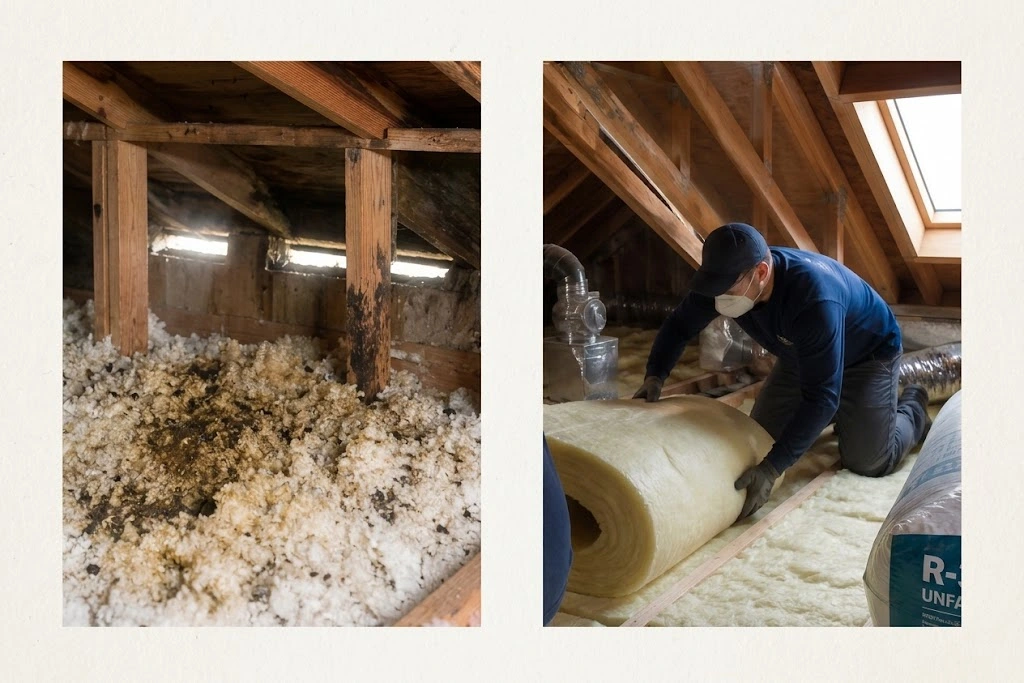
side by side attic image and a person cleaning the attic

Key Takeaways

  • The correct first call depends on whether the carcass is on a freeway, county road, public property, private property, or inside a structure.
  • San Bernardino County lists different contacts for freeways, county roads, private-property reports, and large deceased animals.
  • Keep children and pets away, avoid bare-handed contact, and do not enter confined spaces to search for a carcass.
  • Hidden dead animals can require locating, retrieval, sanitation, odor treatment, and access-point repairs not just pickup.
  • Ask for a written scope that separates removal, disposal, cleanup, deodorization, repairs, and exclusion.
Attic Clean & Repair Services, Riverside Attic Clean and Repair

Frequently Asked Questions

Sometimes. San Bernardino County Animal Care lists separate contacts for deceased stray animals on private property, county roads, freeways, and large animals. The City of San Bernardino lists deceased animals on public property among its field-service calls. Because agencies have different boundaries and access limits, confirm the address and location before assuming a city or county crew will enter private structures.

San Bernardino County’s Field Services page lists Caltrans for deceased stray animals on freeways and provides 909-383-4631. Do not approach a carcass in traffic or stop in an unsafe location. If the animal is on a city street or county road instead, use the local agency listed for that road authority and provide the exact location and direction of travel.

Keep people and pets away, do not touch or move it, and contact the local animal-care agency or a private wildlife-removal provider. San Bernardino County lists 800-472-5609 for deceased stray animals on private property within its service area. If the carcass is hidden under a house, inside a wall, or in an attic, ask for a provider that can locate and retrieve it safely.

That depends on access, the animal, and the approved service scope, but hidden locations are a common reason homeowners use private wildlife removal. All City Animal Trapping’s public dead-animal service page lists crawlspaces, walls, ductwork, decks, and other difficult areas among the locations it handles. Ask whether the estimate includes access, removal, disposal, sanitation, odor treatment, and any repairs.

No. The CDC advises people not to pick up or touch dead animals with bare hands and recommends keeping pets away from wildlife. If contact has already occurred, wash exposed skin and hands. For a bite, scratch, saliva exposure, or possible bat contact, wash the wound with soap and water and speak with a healthcare provider or public-health authority about next steps.

There is no dependable timeline because odor depends on the animal’s size, location, temperature, ventilation, moisture, and the materials affected. A carcass in an open yard may behave differently from one inside insulation, a wall, or a crawlspace. Removing the source is the first step; sanitation, deodorization, and replacement of affected porous material may be needed when odor persists.

Not automatically. Some public pickups focus on collecting and disposing of an accessible carcass, while private providers may offer additional sanitation, deodorization, contaminated-material removal, or exclusion. Ask for each item in writing before approving work. All City Animal Trapping’s public service information describes removal, cleaning, odor treatment, and entry-point assessment, with actual scope determined by the property and findings.

Provide the address or community, whether the animal is on public or private property, the exact location, whether it is visible, the suspected species and size, how long the odor has been present, and whether flies or other insects are present. Mention any bite, scratch, saliva, or bat exposure. Photos can help, but take them only from a safe distance.

Need dead animal removal on private property in San Bernardino?

If the carcass is under your home, inside a crawlspace, behind a wall, in an attic, or anywhere a public crew is unlikely to retrieve it, the next step is a property-specific assessment. Contact All City Animal Trapping or call (877) 724-5314. Be ready to share the community, public or private location, visibility, suspected species, odor, insect activity, and any possible bite or scratch exposure. For the broader question of who to call in Southern California, read ACAT’s guide on who to call to pick up a dead animal near you.

Reviews

Based on over 2000 reviews

Cecily L.
We had such a great experience with All City Animal Trapping. We got the Platinum package, and it was well worth the investment! The team was easy to reach and very responsive. Blake handled everything on site. He was very nice and communicative, showed up on time, and took care of our attic from patching to trapping and everything else. You'd never even know he was here! We're critter free which has given us peace of mind. 100% recommend All City!
Jackie Poles Ran
We really wanted a service that provided live trapping since we didn’t want to kill any animals but we didn’t want them living in our attic either! Pete was great! He was a great communicator and always kept us appraised of what he did and what he recommended. This was at our rental property and he always accommodated our tenants schedule. They are not the cheapest service but they did a great job and I’d definitely use them again.
Eileen C.
Great experience. Kevin was very thorough, patient and professional. He looked through our attic and roof area, fixed the hole in the attic and provided other recommendations.
Angela M.
Unwelcome guests in the attic! Rats! Called All City Animal Trapping, Cole was our technician. He walked around the house and went up into the crawlspace in the attic to assess the entry point. He found an opening in the attic and sealed it off, and set multiple traps. Then he followed up in a week. We caught one! He did a great job, and good attitude. Thank you!